Posts mit dem Label History werden angezeigt. Alle Posts anzeigen

Montag, 3. November 2025

Goryōkaku Hakodate – Visiting the Star Fortress from Detective Conan

Chasing the Star Fortress – A Visit to Goryōkaku in Hakodate

For many years, Goryōkaku had been sitting firmly on my personal travel bucket list. The famous star-shaped fortress in Hakodate is one of the most recognizable historical sites in Hokkaidō. After seeing it prominently featured in the recent Detective Conan: The Million-Dollar Pentagram film, the urge to finally visit became irresistible.

Naturally, my plan was a little more ambitious than the typical sightseeing stop.

A Drone Flight That Never Happened

I had applied for an official drone flight permit to capture the fortress from above. The geometric perfection of Goryōkaku almost demands an aerial perspective. After all, the full star shape only becomes visible from above, especially a 90°-angle was the idea.

At first, my permit was approved — only to be revoked later, which was honestly heartbreaking, yet it was not revoked by the MLIT itself but by a female administration worker of the nearby tower. Applying at the MLIT is only step one, you need to apply at the town hall of Hakodate as well. Being there only 2 days made it impossible to apply at the townhall and shifting my pre-approved time slot, therefore I did the application process for nothing.

Because of being unable to do a drone shot, I walked around the whole park, took a few shots of the momiji Autumn leaves and practised a little with my DJI OSMO Pocket that I bought in Germany before coming to Japan and my new DJI OSMO 360 that I bought in Akiba just a few days, ago.

One of the main reasons I traveled all the way north to Hokkaidō was exactly that: photographing Goryōkaku from the sky.

To make the trip possible, I purchased the JR East-South Hokkaidō Rail Pass, which allowed several days of Shinkansen travel between Tōkyō and southern Hokkaidō.

Riding the Shinkansen to Japan’s Northern Frontier

The journey itself is already an experience. From Tōkyō, the trains of the Tōhoku Shinkansen continue north as the Hokkaidō Shinkansen.

The fastest service on this route is the Hayabusa Shinkansen, which travels from Tōkyō through northern Honshū before entering the famous Seikan Tunnel beneath the Tsugaru Strait.

This tunnel connects the islands of Honshū and Hokkaidō and remains one of the longest undersea railway tunnels in the world.

The journey from Tōkyō to Shin-Hakodate-Hokuto Station takes roughly four hours, followed by a short local train ride into Hakodate.

Interestingly, the Shinkansen currently stops there. The extension toward Sapporo is still under construction. Traveling from Hakodate to Sapporo therefore requires the Limited Express Hokuto and takes around 3.5–4 hours.

Because my itinerary also included stops in Sendai and Morioka, and the rail pass only allowed a limited number of days, a detour to Sapporo unfortunately wasn’t possible this time.

Anime Tourism: When Fiction Inspires Travel

Hakodate and its star fortress recently gained renewed attention thanks to the long-running franchise Detective Conan, created by Gosho Aoyama.

The 2024 film Detective Conan: The Million-Dollar Pentagram prominently features Hakodate and Goryōkaku as part of its mystery storyline.

Anime tourism has become a powerful cultural phenomenon in Japan, with fans traveling to real-world locations that appear in their favorite series.

Returning to Hokkaidō After Many Years

My previous visit to Hokkaidō dates back to January 2016, during my Working Holiday year in Japan.

At the time I participated in WWOOFing, which led to some unforgettable experiences. One of them involved sleeping in a treehouse during winter with more than one meter of snow outside.


Later I worked in an izakaya at the ski resort of Rusutsu Resort.

During that same winter I also visited the famous Sapporo Snow Festival and even had a surprisingly memorable Tinder date with a traveler from Hong Kong.

Although I would have loved to revisit Sapporo again — preferably at a warmer time of year — the limited validity of the rail pass and my travel schedule simply didn’t allow it.

A Familiar View with a Personal Twist

So yes — the drone flight above Goryōkaku never happened.

And technically the photo I captured is the same viewpoint millions of visitors take every day and every year.

But at least I tried to give it a personal touch.

Using a tilt-shift lens, I experimented with perspective and focus to create a miniature-style interpretation of the fortress. It’s a small artistic twist on a very famous scene. I always try to do some unique shots wherever I go in Japan and at some point there is barely any other way of doing exactly that except by either using a drone or a special lense.

Standing above the star-shaped fortress also triggered a small linguistic joke. Coming from Leipzig, the word Stern inevitably reminds me of Sternburg, a well-known local beer brand.

The idea of a “Sternenburg meets Sternburg” moment is admittedly a funny wordplay — although I should clarify one thing: I actually don’t drink beer at all. In fact, I generally avoid alcohol almost entirely.

So the connection remains purely linguistic.

Still, it felt strangely fitting that a star fortress in Japan would remind me of a Leipzig beer name — even if only as a playful coincidence.


Mittwoch, 6. August 2025

Hiroshima - remembering a tragedy

This day is always tricky for me, because on the one handside it's my birthday and on the other it's the day that might have been the most tragic day in human history.

Today marks the 80th anniversary of one of the most devastating events in human history: the atomic bombing of Hiroshima. On the morning of August 6, 1945, near the end of World War II, the United States dropped the first atomic bomb ever used in warfare over the city. The weapon, nicknamed Little Boy, was released from the Boeing B-29 Superfortress Enola Gay at approximately 8:15 a.m., detonating high above the city center. In an instant, an enormous blast and heat wave destroyed much of Hiroshima and killed tens of thousands of people; many more died later from injuries and radiation sickness.

The bomb exploded almost directly above the Hiroshima Prefectural Industrial Promotion Hall—about 600 meters in the air. Because the detonation occurred nearly overhead, the building’s central structure remained partially standing even though everything around it was flattened. Its exposed steel dome became one of the most recognizable symbols of the bombing. Today the preserved ruins are known worldwide as the Hiroshima Peace Memorial (Genbaku Dome), or simply the A-Bomb Dome. Rather than demolish the damaged structure, the city chose to preserve it as a memorial to the victims and as a reminder of the destructive power of nuclear weapons.


The dome now stands within the Hiroshima Peace Memorial Park, an area dedicated to remembrance and peace. Every year on August 6, ceremonies are held there to commemorate those who died and to renew calls for nuclear disarmament. Bells are rung, names of victims are remembered, and a moment of silence is observed at exactly 8:15 a.m., the time of the explosion.

This anniversary also makes me think about my own visit to Hiroshima in the spring of 2024. Early one morning, around 8:30 a.m., I arrived at Hiroshima Castle to do my first drone flight above the castle grounds. The quiet of the morning and the calm atmosphere around the reconstructed castle made the moment feel almost timeless. Standing there, it was hard to imagine that the city had once been almost completely destroyed.


Later that same day I traveled to Miyajima and visited the famous Itsukushima Shrine. I arrived at low tide, when the great torii gate stands directly on the exposed seabed rather than floating in the water. Being able to walk out toward it and capture the scene with my drone offered another powerful perspective on the region—one defined not by destruction, but by beauty, culture, and continuity.


This year’s anniversary carries special weight. Eighty years have passed since the bombing, meaning that the number of surviving witnesses—known in Japan as hibakusha—is rapidly declining. Many of them have spent decades sharing their experiences in the hope that future generations will understand the human cost of nuclear war. The 80th anniversary has therefore been marked by renewed global reflection on the dangers posed by nuclear weapons and the importance of preserving historical memory.

Remembering Hiroshima is not only about the past; it is also about the future. The A-Bomb Dome remains standing not as a monument to destruction, but as a symbol of resilience and a warning. Eight decades later, it continues to remind the world of what happened on that morning in 1945 and why such a tragedy must never happen again.

Dienstag, 13. April 2021

It's a long way

Indeed it is and I don't mean the pilgrimage on Shikoku - I hope my next approach will be better - I am actually talking about the Kickstarter campaign for my illustrated book.

We've already achieved ~20% but there is still a lot left.

Uwajima

Beside the project page of 日本の城 - Japanese Castles I will show you a few pages of the book giving you a better idea of the book and its 292 pages with 400+ pictures of 19 castles.

There won't be any text, except for the preface giving you the opportunity to completely focus on the pictures. Every chapter is having one page with a family crest, this resemples the daimyo (samurai lord) clan that either build or is connected the most to the history or the relevance of that specific castle, e.g. Fushimi/Momoyama castle in Kyoto got the emblem of the Toyotomi clan, who's leader Hideyoshi built the castle, in Uwajima it's a mixture between the Ashina and Date clan and a 3rd example is about Kiyosu castle which was the residence of Oda Nobunaga.

I would appreciate every support - Thank you!

Aizu-Wakamatsu in Fukushima

Kiyosu Castle in Nagoya

Osaka

Fushimi

Okayama

Hiroshima


Samstag, 3. April 2021

日本の城 - Launching next week

After setting up everything we will finally launch 日本の城 - Japanese Castles next week.

I've been working on this artbook about Japanese castles for a few months now and after receiving copies for proof reading last week we can finally go live next week. In this book I share over 400 pictures of 19 Japanese castles on 292 pages.


The Kickstarter campaign will be launched next week: https://lnkd.in/dxFyw86 Please join and support my project to help me publishing this book and make my dream of self publishing come true. Thank you for your support


Freitag, 12. März 2021

日本の城 - New photo project on the horizon about Japanese Castles

After successfully finishing my first campaign on Kickstarter about Postcards from Japan's North to South, presenting postcards from Hokkaido to Okinawa, I am currently working on my next project.

日本の城 - Japanese Castles

This project is a picturebook about 19 Japanese castles on 280+ pages. It's been a dream to publish a book about my photos of Japan for years and now I am finally working on it and it's coming soon. hopefully in April.

Here's a small teaser of a few pictures that will end up in the book 🏯

Enjoy and join my campaign💪🙏


Mittwoch, 14. September 2016

Picture of the Day #20 Shinto Marriage at Meiji Shingu

I've visited the Meiji Shingu in Tokyo many times, it's named after Emperor Meiji like the Meiji era / Meiji Restauration as well. This was the historical period where Japan opened to the West, a good movie about that is "Last Samurai" with Tom Cruise or the Manga "Kenshin" and the Anime "Rurouni Kenshin" by Nobuhiro Watsuki.

The easiest way to get to the Yoyogi Park is by getting off at the JR or METRO station of Harajuku

Every Sunday you can see many of those shinto marriages. In this picture the husband and wife to be are under the umbrella, just behind the 2 Miku. Behind the couple the parents and the grandparents are walking.

In this ceremony the bride is "packed" like a gift that is handed over to the broom's family. Taking a big family photograph is also part of that.

Other daily pictures can be found in the Picture of the Day section and on INSTAGRAM, where you can also find a few more pictures about my many trips to Japan, as well as some video game stuff.

Direct Link: Instagram


Freitag, 9. September 2016

Picture of the Day #15 - Osaka Castle from above

I've been to the Osaka Castle many times already. When I went there the first time I had been living in Izumi as woofer at a acompany that recycles old video games and modifies consoles, I went to Osaka to meet my friends. The castle is a nice spot in every season.

I ever wanted to see that castle, because it's a very beautiful one and it was very important in uniting Japan. The Castle was built by Toyotomi Hideyoshi. Today inside of the castle itself there is a museum with astonishing historical artefacts.

Find the other Pictures of the Day and INSTAGRAM for More

Now enjoy the view from the roof of the castle


Mittwoch, 7. September 2016

Picture of the Day #13 - 47 Ronin

Today's Picture of the Day has been taken at the graveyard of the Sengaku-Ji. That's the temple where the 47 Ronin are burried.

The story of the 47 Ronin is about 47 Samurai and their Daimyo (Lord) who has been beheaded, because he has been drawing his sword at another Lord's fortress, which was a crime. Their Daimyo's death made them all stray Ronin.

To win their Lord's honor back they had to kill the their "enemy". After accomplishing this, they all were found guilty and beheaded, too, but they had reclaimed the honor of their master.

It's a story about honor and loyalty, as a gift for being that loyal, the 47 ronin were burried next to their master at Sengaku-Ji.

There are more Pictures of the Day and also my INSTAGRAM

Now enjoy the Picture:


Samstag, 3. September 2016

Hiroshima Castle - Picture of the Day #9

I've seen a few Japanese Castles, but most of them are completely made of stone.
This castle's facade is made out of wood as you can see.

Hiroshima is a very nice place, you can explore a lot, Miyajima Island with the famous Itsukushima Shrine with its red Torii, the A-Bomb Dome, the Piece Momunent and many other places, also for pop culture, e.g. the Pokémon Center.

Close to the castle there's one of my favorite shines, especially because of the stamp and writing they gave me for my shuincho.

Click here for my INSTAGRAM and further Pictures of the Day

Anyway, enjoy Hiroshima Castle:

Freitag, 2. September 2016

Sanja Matsuri - Picture of the Day #8

In May on the 3rd FR-SU at the Asakusa Jinja in Tokyo you can enjoy the Sanja Matsuri. The Asakusa Jinja is directly next to the Buddhist Senso-Ji Temple. Today's Picture of the Day has been taken at the Evening of the first day.

Here are further Pictures of the Day and INSTAGRAM

Enjoy:

Mittwoch, 25. November 2015

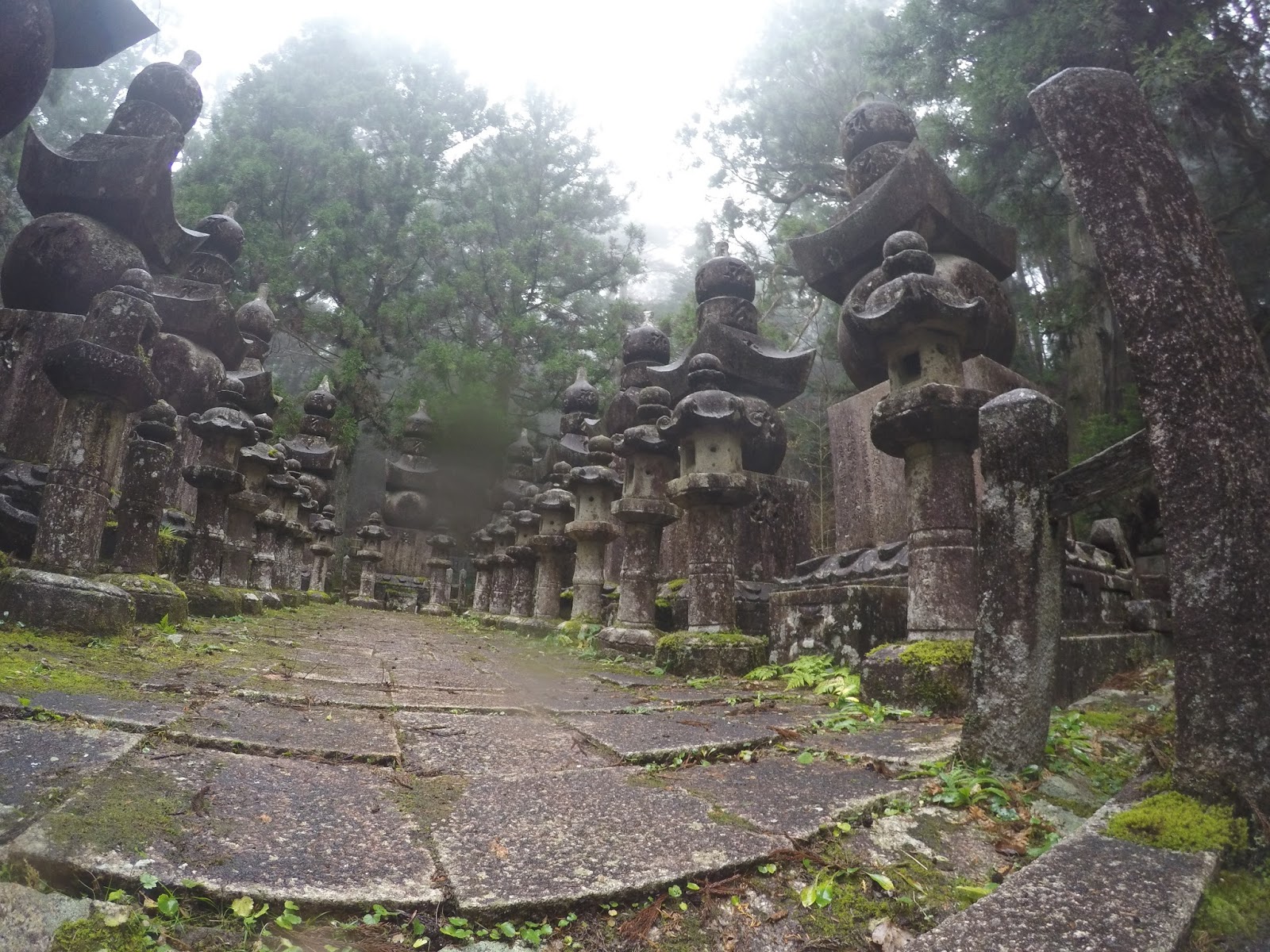
Rain, Mist and some spiritual appearances @Kōya-san

Kōya-san - It's the center of the Shingon Buddhism which was founded by Kūkai.
A spiritual place with hundrets of temples and a giant graveyard with famous historical graves (e.g. Date Masamune, etc.) which is leading to Kūkai himself.

People pray to him, especially pilgrims who went or want to go on the pilgrimage on Shikoku pray to him for a safe journey or to "report" their experience.

When I came here, there was a special flaire, maybe it was just the rain and mist, but it felt much spiritual than just some sort of weather, you will understand, when you see those specific pictures.

Here they are - Mt. Kōya


When I come here next time, I will pray for a safe pilgrimage myself.
PEACE OUT!!!